
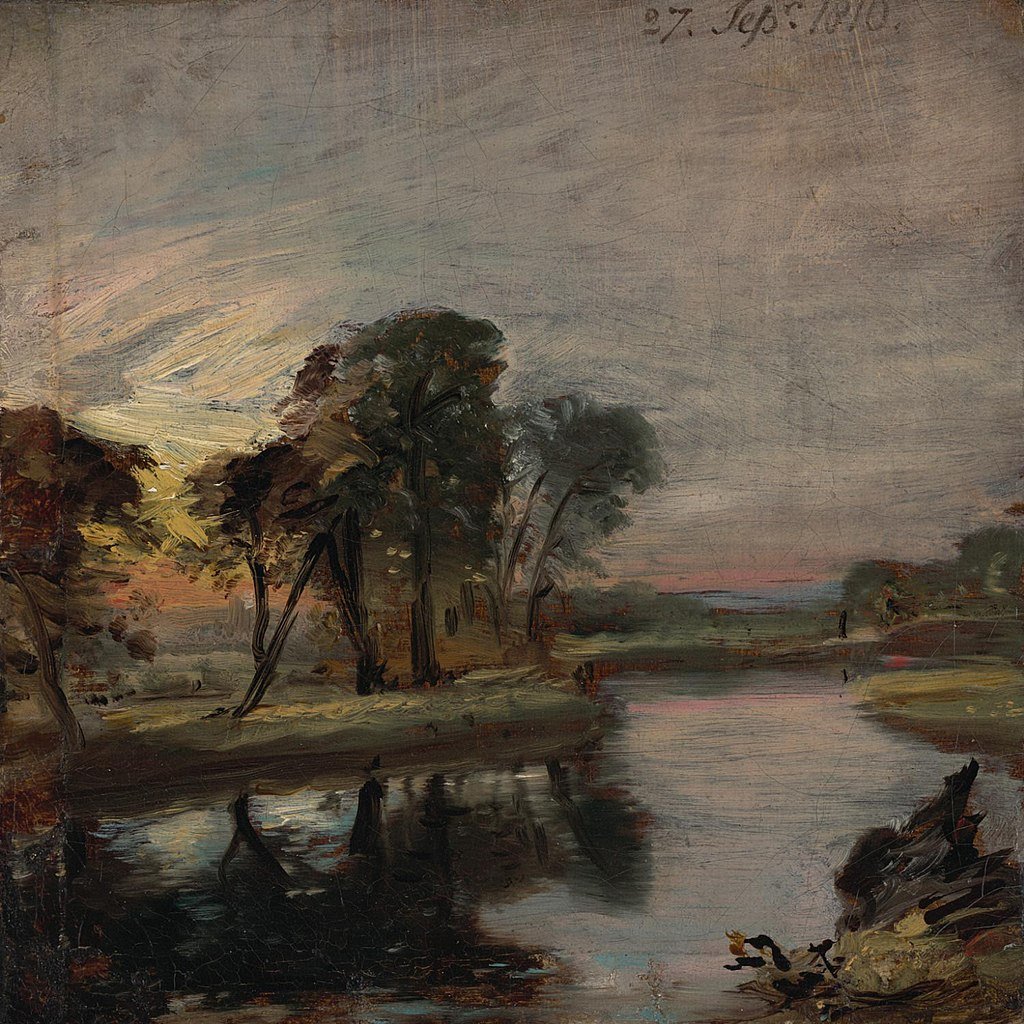
The Stour is an 1810 painting by English Romantic landscape artist John Constable. This work is located in the Philadelphia Museum of Art in Philadelphia, Pennsylvania.
The River Stour in the early 1800s was a defining feature of the landscape in East Anglia, flowing through Cambridgeshire, Suffolk, and Essex before reaching the North Sea at Harwich. This river, approximately 47 miles long, played a significant role in shaping both the economy and culture of the rural communities along its banks. During the early 19th century, the Stour was a key waterway for transportation, trade, and agriculture, and its picturesque scenery inspired some of the most famous works of English landscape painting.
Economic Importance
The River Stour was crucial for trade and transportation in the early 1800s. Although the Industrial Revolution was in full swing, the Stour region remained largely agrarian, with the river serving as a conduit for moving goods, particularly agricultural products. Barges, or flat-bottomed boats, were used to carry grain, hay, wool, timber, and other goods between local markets and larger towns like Sudbury, Manningtree, and Colchester. The Stour Navigation, a canal system developed in the 18th century, allowed for the efficient movement of these goods, making the river a vital economic artery in the region.
The Stour was also lined with watermills, which used the river’s flow to grind grain into flour, a crucial aspect of the local agricultural economy. Mills like those at Dedham and Flatford (where John Constable’s father operated a mill) were integral to local life, providing not only essential services but also employment for many families in the area.
Agricultural and Social Life
In the early 19th century, agriculture was the primary occupation for those living along the Stour. The fertile lands of the Stour Valley produced grain, fruits, and vegetables, and livestock farming was also common. The river supported irrigation and provided water for livestock, making it essential to the prosperity of local farms. Villages like Higham, Dedham, Flatford, and Nayland were deeply connected to the river, and it often served as a gathering place for residents, whether for practical tasks like washing and fishing or for recreational activities.
While the Stour was primarily a working river, it was also a place of natural beauty, appreciated by those who lived near it. The lush meadows and gently rolling hills of the Stour Valley were characteristic of this pastoral landscape, and the river’s course through the countryside created an idyllic environment that inspired artists and poets alike.
Cultural Significance and Artistic Legacy
Perhaps the most enduring legacy of the River Stour in the early 1800s is its influence on the art of John Constable, one of England’s most celebrated landscape painters. Born in East Bergholt along the Stour, Constable grew up surrounded by the river and its landscapes, which became the central theme in many of his most famous works. His paintings, such as “The Hay Wain” and “Flatford Mill,” captured the serene beauty of rural life along the Stour. His work immortalized the river and its surrounding countryside, contributing to the Romantic vision of an unspoiled rural England.
Constable’s paintings not only celebrated the Stour’s natural beauty but also recorded the daily life and activities of the people who lived along its banks. Through his art, the River Stour became a symbol of the harmony between nature and human labor, a theme that resonated deeply in the 19th century, as industrialization threatened to disrupt rural life.