
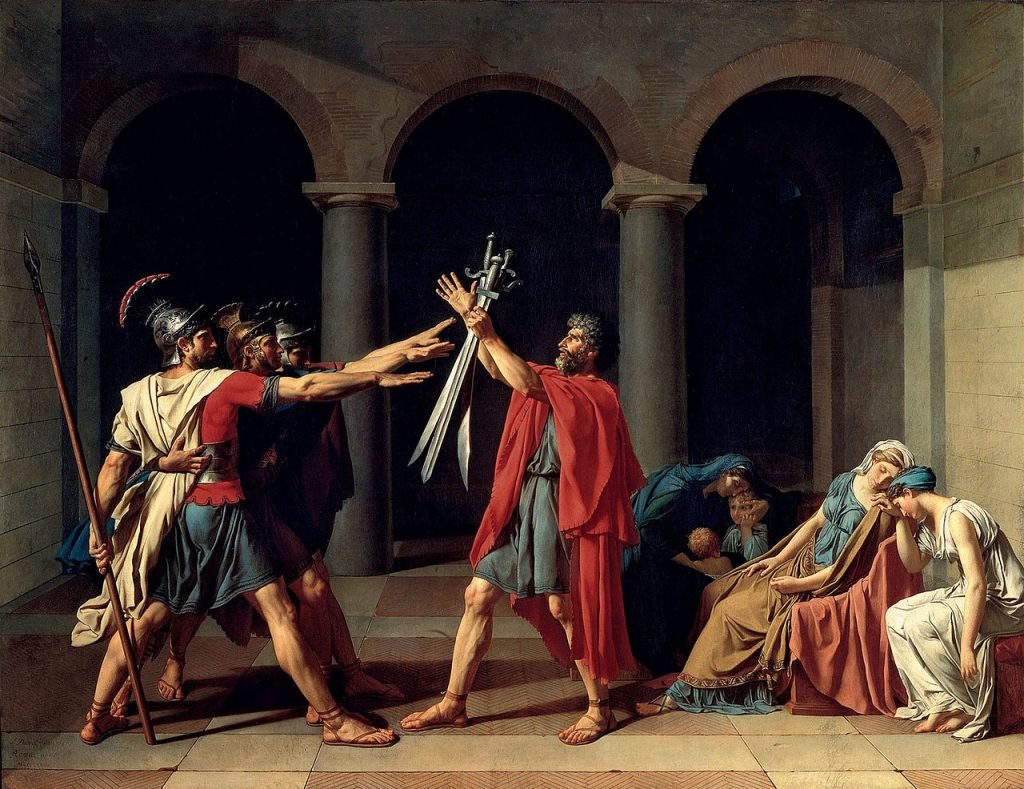
The Oath of the Horatii is a 1785 painting by French Neoclassical artist Jacques Louis David. This work is located in the Louvre in Paris, France.
The Story of The Oath of the Horatii
The subject of The Oath of the Horatii is derived from a Roman legend, famously recounted by the Roman historian Livy. The story is set in the 7th century BCE, during a conflict between two neighboring cities: Rome and Alba Longa. To avoid a full-scale war, the two cities decide to settle the dispute by choosing three champions from each side to fight to the death. The three Horatii brothers are selected to represent Rome, while the three Curiatii brothers fight for Alba Longa.
In David’s painting, the Horatii brothers swear an oath to their father to fight for Rome and defend its honor at all costs, even if it means sacrificing their own lives. The father, Horatius, holds out three swords, which the brothers reach for with determination and resolve. The central theme is the unwavering commitment to duty and loyalty to one’s country, symbolized by the brothers’ willingness to die for Rome.
Historical and Political Context of The Oath of the Horatii
By the late 18th century, Enlightenment ideas promoting reason, civic duty, and individual responsibility were spreading across Europe. Philosophers like Rousseau and Voltaire questioned the traditional authority of the monarchy and the Church, advocating for social equality, rational governance, and the greater good of society. Neoclassicism, an artistic movement inspired by the ancient civilizations of Greece and Rome, emerged as a visual manifestation of these values. David, the leading Neoclassical painter, embraced these ideals and sought to reflect them through his art.
Jacque Louis David’s The Oath of the Horatii symbolizes loyalty, sacrifice, and duty to the state—virtues that resonated with the revolutionary fervor building in France. The painting, with its emphasis on civic virtue over personal emotion, presented a moral lesson. The Horatii brothers swear to fight for Rome, even though it means killing their family members in the process. This act of sacrifice for the greater good mirrored the Enlightenment’s call for commitment to the collective will.
At a time when France’s aristocracy was increasingly viewed as decadent and self-serving, David’s portrayal of stoic male heroes ready to sacrifice for their country was seen as a critique of the ruling class. The painting became a symbol of revolutionary ideals, advocating for public duty over personal interests, reflecting the political winds that would soon sweep through France during the Revolution.
The Painting’s Legacy
The legacy of Jacques-Louis David’s The Oath of the Horatii extends far beyond its immediate artistic acclaim, as it has become a powerful symbol of civic virtue, patriotism, and the ideals of the Enlightenment. Completed in 1784, the painting played a pivotal role in shaping the Neoclassical movement and influencing generations of artists and political thinkers.
Emerging just before the French Revolution, The Oath of the Horatii resonated with the revolutionary spirit that sought to prioritize duty to the state over personal interests. Its themes of sacrifice, loyalty, and honor mirrored the values championed by revolutionaries and provided a moral framework that supported their cause. As such, the painting became an emblem of the revolutionary ethos, celebrated for its promotion of civic responsibility.
David’s work also set the stage for the Neoclassical style, emphasizing clarity, order, and rationality. His use of strong lines, heroic poses, and dramatic expressions influenced not only his contemporaries but also future movements, including Romanticism and Realism. Artists such as Ingres and Delacroix acknowledged David’s impact, and his principles of moral clarity and historical narrative remained relevant in the art world.
Beyond its aesthetic impact, The Oath of the Horatii has been utilized in educational contexts to discuss the intersection of art, politics, and society. It serves as a visual reference for discussions on the role of sacrifice in the name of national identity and the ethical dilemmas faced by individuals in times of political upheaval.
Today, the painting is housed in the Louvre Museum, where it continues to inspire viewers with its dramatic narrative and moral complexity. Its legacy endures as a quintessential example of how art can encapsulate and propagate the values of its time, making it a timeless reflection on the nature of duty and sacrifice in the pursuit of the common good.