
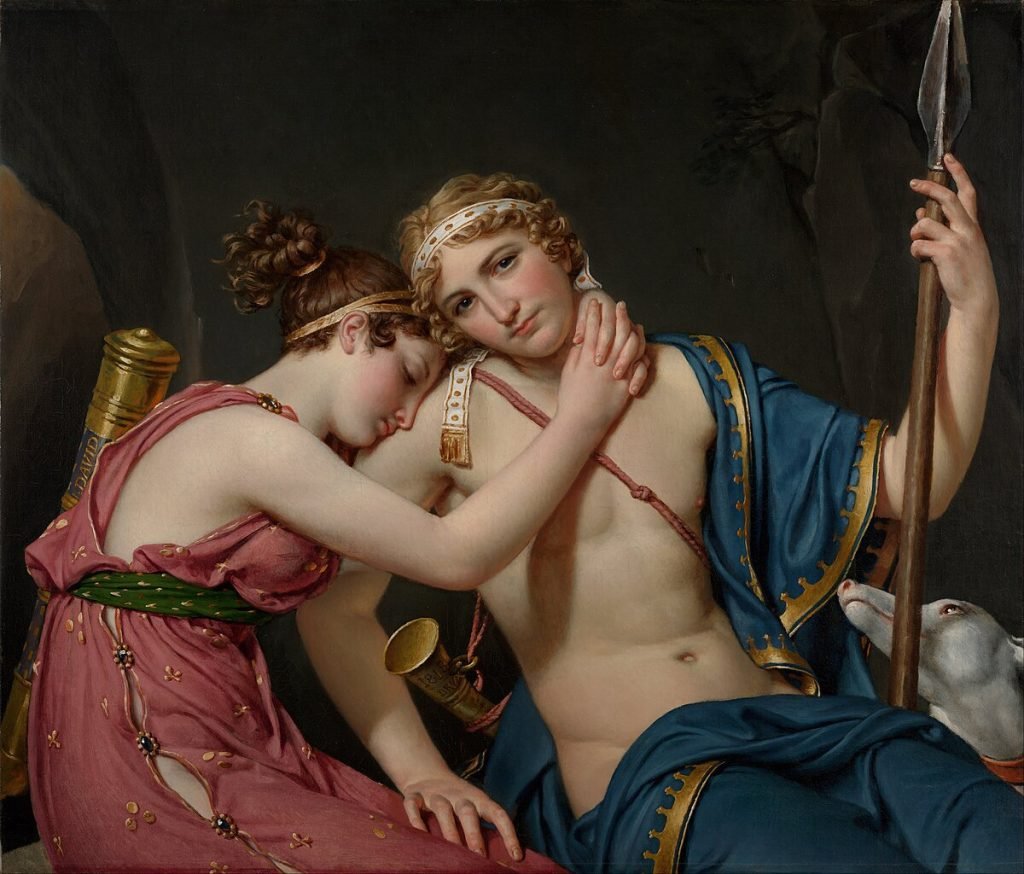
The Farewell of Telemachus and Eucharis is an 1818 painting by French Neoclassical artist Jacques-Louis David. This work is located in the J. Paul Getty Museum in Los Angeles, California.
The Farewell of Telemachus and Eucharis is a poignant scene from François Fénelon’s 17th-century novel Télémaque. The story is set during Telemachus’s journey to discover his father Odysseus’s fate and encompasses themes of love, duty, and parting.
In the narrative, Telemachus, the son of Odysseus, is traveling across the Mediterranean in search of his father, who has been absent from Ithaca for many years. During his travels, Telemachus encounters Eucharis, the beautiful and noble daughter of the king of the island of Calypso. The two develop a deep bond, with Eucharis becoming a symbol of love and emotional support for Telemachus.
As Telemachus prepares to continue his quest, the time comes for him to say goodbye to Eucharis. Their farewell is deeply emotional, marked by a sense of impending separation and the weight of unfulfilled promises. Eucharis expresses her sorrow and devotion, while Telemachus, though committed to his journey and the search for his father, is visibly affected by the departure.
The scene captures the intensity of their feelings and the tragic nature of their parting. Telemachus’s departure symbolizes the sacrifices made in the pursuit of duty and destiny, while Eucharis’s emotional farewell reflects the personal cost of such quests.
Their farewell is significant not just for its emotional depth but also for its representation of the broader themes in Télémaque: the conflict between personal desires and obligations, and the enduring nature of love even in the face of separation. The scene underscores the universal experience of parting and the poignant realization that some relationships are constrained by circumstances beyond one’s control.