
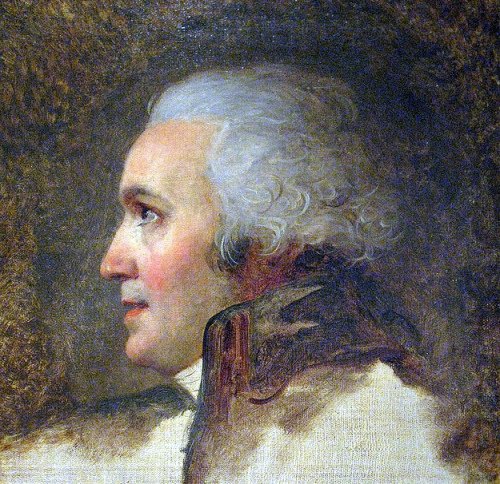
This Unfinished Portrait of Rabaut Saint-Etienne is a 1791 painting by French Neoclassical artist Jacques Louis David. This work is located in the Huntington Library in San Marino, California.
Biography of Jean-Paul Rabaut Saint-Étienne
Jean-Paul Rabaut Saint-Étienne was a significant figure during the French Revolution, known for his political activities, contributions to religious tolerance, and his tragic end. Born on November 14, 1743, in Nîmes, France, he was the son of Paul Rabaut, a prominent Huguenot pastor. His upbringing in a Protestant family during a time of religious persecution in France deeply influenced his later work and advocacy for religious freedom.
Rabaut Saint-Étienne was well-educated and followed in his father’s footsteps, becoming a pastor. His eloquence and dedication to the Huguenot cause made him a leading figure in the movement for religious tolerance. In 1785, he published Letters to Monsieur de Voltaire, a work defending the rights of Protestants in France and advocating for religious equality. This work and his other writings earned him recognition as a prominent voice for religious freedom.
As the political climate in France began to shift towards revolution, Rabaut Saint-Étienne became increasingly involved in the revolutionary movement. In 1789, he was elected as a deputy to the Estates-General for the Third Estate, representing the city of Nîmes. This assembly, which eventually became the National Constituent Assembly, was a pivotal body in the early stages of the French Revolution. Rabaut Saint-Étienne played an active role in its deliberations, advocating for constitutional reforms and the establishment of a more just and equitable society.
One of his most notable achievements was his involvement in the drafting of the Declaration of the Rights of Man and of the Citizen in 1789. This landmark document, which proclaimed the fundamental rights and freedoms of all individuals, was a cornerstone of the Revolution and has had a lasting impact on human rights discourse worldwide. Rabaut Saint-Étienne’s contributions to this document reflect his deep commitment to principles of equality, liberty, and justice.
Despite his early successes, Rabaut Saint-Étienne’s fortunes changed as the Revolution became more radical. As a moderate, he opposed the more extreme measures advocated by the Jacobins and other radical factions. His political stance put him at odds with the dominant forces in the National Convention, the revolutionary government that succeeded the National Constituent Assembly.
In 1793, during the Reign of Terror, Rabaut Saint-Étienne was arrested along with other moderate leaders. The Reign of Terror was a period characterized by political purges and mass executions aimed at eliminating perceived enemies of the Revolution. Rabaut Saint-Étienne was accused of conspiring against the Republic and was subsequently executed by guillotine on December 5, 1793.