
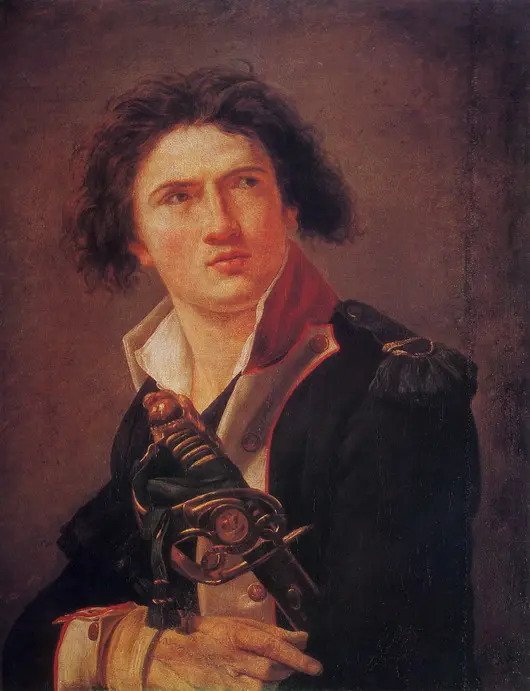
Portrait of Lazare Hoche is a 1793 painting by French Neoclassical artist Jacques Louis David. This work is located in the Khanenko Museum in Kyiv, Ukraine.
Lazare Hoche (1768-1797) was a prominent French general during the Revolutionary Wars. Born in Versailles, France, Hoche came from humble beginnings. He enlisted in the French Army at a young age and quickly rose through the ranks due to his natural leadership abilities and military acumen.
Hoche’s military career began in the French Guards, and by 1792, he had become a captain. His rapid advancement continued with the outbreak of the French Revolution, which created opportunities for talented officers. By 1793, at the age of 25, Hoche was promoted to general, thanks to his successes in the defense of Dunkirk and other battles against coalition forces.
Hoche is perhaps best known for his role in suppressing the Royalist insurrection in the Vendée. Appointed commander of the Army of the West, he implemented a strategy of both military action and conciliation, which eventually quelled the uprising. His ability to combine military prowess with political negotiation earned him considerable respect.
In 1795, Hoche played a crucial role in the failed Quiberon expedition, where he decisively defeated the British-supported Royalist forces attempting to land in Brittany. This victory further cemented his reputation as a capable and reliable commander.
In 1797, Hoche was appointed commander of the Army of Sambre-et-Meuse. He also played a significant part in planning a potential invasion of Ireland to support Irish rebels against British rule, although this plan never came to fruition.
Tragically, Hoche’s promising career was cut short when he died suddenly in 1797 at the age of 29, likely from tuberculosis. Despite his brief life, Hoche’s contributions to the French Revolutionary Wars were significant, and he is remembered as one of the era’s most talented generals, embodying the revolutionary ideals of merit and dedication to the republic.